The Best Automatic Litter Boxes for Your Cat
We ranked, reviewed, and sorted 6 of the Best Automatic Litter Boxes by what your cat actually cares about.
If you share your home with a cat, you know the drill: scoop, scoop, scoop, every single day. Automatic litter boxes promise to end that chore for good — but with so many options on the market now, ranging from $200 to nearly $700, how do you know which one is actually worth it?
We dug deep into six of the most talked-about automatic litter boxes of 2025, examining real-world reviews, design philosophy, cleaning mechanisms, cat acceptance rates, and ongoing costs. We’ve rounded up our full reviews below, plus an interactive comparison table you can sort by price or rating to find the best fit for your household.
The bottom line up front? One box stood head and shoulders above the rest — not just for humans, but more importantly, for the cats themselves.
🏆Popur X5 Self-Cleaning Cat Litter Box — Our #1 Recommendation
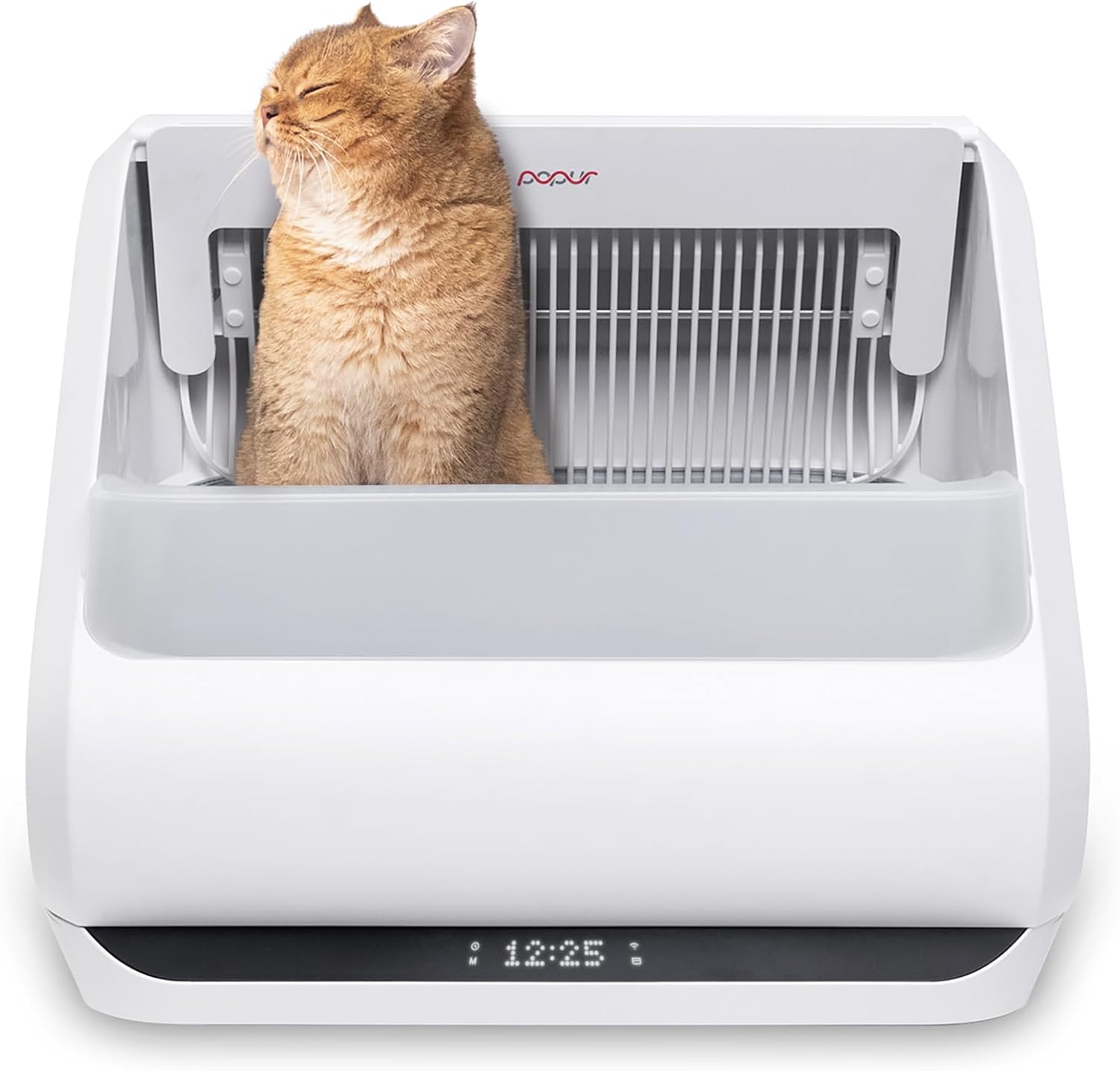
After reviewing all six options, the Popur X5 earns our top spot thanks to its brilliant open-top design that cats genuinely love, an industry-redefining split-system that removes waste into a completely separate sealed bin, the remarkable ability to hold an entire 30-pound bag of clumping litter in one load, and an overall simplicity that makes setup and daily use almost effortless. Cats who refused other automatic boxes — including the Litter Robot — took to the Popur X5 almost immediately. It’s the rare product that works better for both the human and the animal.
Full Reviews
Popur X5 Self-Cleaning Cat Litter Box ⭐ Top Pick
Split-System Open-Top Design · Price~$399 Amazon Rating★★★★★ 4.7
The Popur X5 is unlike anything else on this list — and that’s not marketing speak. It pioneered a “split-type” architecture in which waste is funneled through a channel into a completely separate, standalone trash can that sits behind the main litter tray. This means the electronics and the waste never share the same space, which is a genuinely clever engineering solution that keeps the unit cleaner longer and eliminates the funky plastic smell that plagues enclosed competitors.
The open-top, cuboid-shaped litter tray is a massive 24 inches wide — big enough that even large “chonky” cats have unlimited headroom and room to turn comfortably. This is a crucial design choice: studies show that about 60–70% of cats prefer open spaces while doing their business, and owners consistently report that cats who wouldn’t touch other automatic boxes took to the X5 almost immediately.
Then there’s the litter capacity. The X5 can hold up to 33 pounds of clumping litter — meaning you can pour in an entire standard bag at once and not think about refilling for weeks. For multi-cat households and frequent travelers, this is a genuine game-changer. The waste bin itself holds up to a 30-day supply for a single cat, and the dual trash-bag odor sealing system traps 99% of odors at the source before they ever reach the air in your home.
Cleaning is a two-stage tilt mechanism: first gravity sifts the litter, then a “catapult” action launches waste downward — even dislodging sticky clumps and handling runny situations without leaving residue. The interior is leakproof, accessible, and easy to wipe down without full disassembly. An app lets you schedule cycles, track your cat’s health, and enable a “Curious Cat” mode for kittens.
Pros
- Cats love the open, spacious design
- Hold entire 30-lb bag of litter at once
- Separate waste bin = near-zero odor
- Works offline (no WiFi required)
- Supports up to 12 cats
- Aggressive odor sealing
- Easy interior access for cleaning
Cons
- Larger footprint than globe-style units
- Requires a nearby electrical outlet
- Proprietary liner bags needed
Litter-Robot 4 by Whisker
Enclosed Rotating Globe · The Industry OG Price~$699 Amazon Rating★★★★☆ 4.3
The Litter-Robot is the grandfather of automatic litter boxes, and the fourth-generation model is the most refined version yet. The iconic rotating globe silently sifts waste into a sealed drawer below after each use, and the Whisker app provides cat weight tracking, usage history, and litter-level monitoring that are genuinely useful for multi-cat households. It supports up to four cats and includes OdorTrap carbon filtration to manage smells.
Where the Litter-Robot excels is reliability. Whisker has been perfecting this mechanism for over two decades, and the LR4 is whisper-quiet, durable, and well-supported with accessories. If you want a proven, established brand with a long track record and don’t mind the premium price tag, this remains a solid choice.
That said, the enclosed globe design is increasingly being challenged. Many cats — especially larger breeds like Maine Coons — find the entry portal tight and the dark interior intimidating. Some owners report weeks-long transition periods, or cats that simply refuse to use it. At $699, the investment risk is substantial. Ongoing costs are also higher since the drawer liners and OdorTrap packs are proprietary.
Pros
- Proven 20+ year track record
- Excellent app with weight tracking
- Very quiet cleaning cycle
- Good odor containment
- Wide accessory ecosystem
Cons
- Most expensive option on this list
- Enclosed design intimidates some cats
- Proprietary bags add ongoing cost
- Large footprint (24″ diameter globe)
- Some cats take weeks to adapt
PETLIBRO Luma Automatic Cat Litter Box
AI-Camera Waste Analysis · Open-Top Smart Robot Price~$499–599 Amazon Rating★★★★☆ 4.2
Launched in late 2025, the PETLIBRO Luma is the most technologically ambitious litter box in this roundup. It features an AI-powered camera that analyzes your cat’s waste in real time — distinguishing between solid and liquid, identifying consistency changes that could signal health issues — and logs each visit by individual cat (it can recognize up to 10 cats). If you’re a data-driven cat parent who wants genuine health insights, the Luma is extraordinary.
The open-top design is another big win for cat acceptance. Triple-layered safety sensors (visual, weight-based, and infrared) ensure the unit never scoops while a cat is present. A built-in fan pushes air through a carbon deodorizer around the clock, and the waste drawer holds up to seven days of waste for two cats. App connectivity is deep and intuitive, including livestreaming and health alerts if a cat hasn’t visited in 24 hours.
The catch is that the full AI waste-analysis features require a paid cloud subscription, starting at around $10 per month. Without it, you get basic tracking. The Luma is also a newer product with a limited long-term reliability track record, and at its price point, you’re paying a significant premium specifically for the health-monitoring camera features. For health-conscious owners of cats with existing medical conditions, that might be worth every penny.
Pros
- AI camera analyzes waste for health insights
- Recognizes up to 10 individual cats
- Open-top design for cat comfort
- 24/7 carbon-filtered odor control
- 24-hour no-use alerts
Cons
- Full AI features require paid subscription
- Newer product, less proven over time
- Premium price for camera-heavy features
- Must stay off carpet for accurate sensors
Neakasa M1 Plus Open-Top Self-Cleaning Litter Box
Open-Top · Pull & Wrap Waste System Price~$399–499 Amazon Rating★★★★☆ 4.4
The Neakasa M1 Plus has quietly built a devoted following among cat owners who want a premium open-top experience at a price that undercuts the Litter-Robot by $200 or more. Its spacious open-top cabin — supporting cats up to 33 lbs — has been praised by owners of large breeds like Maine Coons who found other automatic boxes simply too cramped. Tom’s Guide, which tested four litter boxes with real cats, found that their feline testers preferred the Neakasa M1 over all other options, including the Litter-Robot 4, using it nearly triple the amount.
The “Pull & Wrap” waste bag system automatically seals the filled liner when it’s time for disposal, which is genuinely convenient. Wi-Fi connectivity tracks usage habits and weight in the app. The unit operates at around 60–65 dB — comparable to a normal conversation — which most cats barely register.
Where it falls short of the Popur X5 is in its waste handling: because waste stays within the main unit’s bag rather than in a truly separate bin, there’s more opportunity for odor to escape between cleanings. The higher entry point can also be a barrier for older or arthritic cats, though Neakasa sells an optional ramp. Single-use plastic consumption from the Pull & Wrap bags is also a consideration for eco-conscious owners.
Pros
- Cats love the open, familiar design
- Excellent value vs. Litter-Robot
- Supports large cats up to 33 lbs
- Wi-Fi app with usage tracking
- Whisper-quiet operation
Cons
- Higher entry point (ramp sold separately)
- Higher ongoing plastic bag usage
- Odor less contained than split-system designs
- Can scatter more litter than enclosed units
Casa Leo Leo’s Loo Too Self-Cleaning Cat Litter Box
UV Sterilization · Alexa & Google Voice Control Price~$499–599 Amazon Rating★★★★☆ 4.0
The Leo’s Loo Too has a loyal fanbase, and it’s easy to see why: it’s handsome, available in four cheerful colors (Baby Blue, Grey, Green, and Pink), and it’s the only automatic litter box on this list with EPA-certified UV-C light sterilization built into the waste drawer. That UV light fires automatically after every cat visit and periodically throughout the day, killing bacteria at the source rather than just masking odors with carbon filters. Combined with a sealed 9.5L waste drawer — 6% larger than leading competitors — the odor control is legitimately impressive.
Smart-home integration is also the most complete of any box here: full Alexa and Google Assistant voice control, a comprehensive app for weight tracking and visit logs, and a whisper-quiet 30 dB motor mean it genuinely can live in a bedroom or kitchen without being intrusive. The triple-layer safety system (radar wall, weight sensors, anti-pinch sensor) has an excellent safety record.
The Leo’s Loo Too is a more polarizing product than its devotees suggest, however. Negative reviews cite units that failed within months, odor issues that persist despite the UV system, and a cleaning mechanism that can leave clumps stuck to the drum walls. It also requires exclusively clay-clumping litter — other litters void the warranty — and at $499–599, reliability concerns at that price point are a real issue. Overall, a stylish and feature-rich option, but not without risk.
Pros
- EPA-certified UV-C bacterial sterilization
- Alexa & Google Assistant voice control
- 4 stylish color options
- Ultra-quiet at 30 dB
- Spacious drum for cats up to 20 lbs
Cons
- Mixed reliability reviews; some units fail early
- Requires only clay-clumping litter (warranty)
- Clumps can get stuck in the drum
- Some users report odor issues despite UV
- Cleaning interior is difficult
PetSnowy SNOW+ Self-Cleaning Litter Box with TiO₂
Enclosed Globe · TiO₂ Photocatalyst Odor Control Price~$499–649 Amazon Rating★★★★☆ 4.1
The PetSnowy SNOW+ brings a genuinely unique odor-control technology to market: a TiO₂ (titanium dioxide) photocatalyst system that breaks down odor molecules and bacteria at a chemical level rather than simply filtering or masking them. Combined with optional Robertet fragrance inserts (adding a subtle, pleasant scent), it’s a thoughtful approach to the smell problem that many enclosed globe designs struggle with. The auto-packing system automatically seals used waste bags — no manual liner pulling required.
The enclosed globe keeps litter scatter minimal, which is a genuine advantage over open-top designs. For multi-pet households, it’s rated for up to four cats, and the seven-stage SnowSafe+ protection system provides robust safety. App connectivity tracks weight and usage from anywhere.
The main challenge with the SNOW+ is cat acceptance. The enclosed, top-entry design with a narrow tunnel entrance can intimidate cats who aren’t already comfortable with covered boxes — some owners report weeks of coaxing before their cat would use it, and some cats never adapt. The interior dimensions (roughly 15″ × 11″) are also on the smaller side, making this a poor fit for larger cats over 15 lbs. Some users have also reported sticky sensor issues and frequent “full” alerts from the waste bin when the bin isn’t actually full. Customer service, however, is widely praised as excellent.
Pros
- TiO₂ photocatalyst destroys odors at source
- Minimal litter scatter (enclosed design)
- Auto-packing waste bags
- Excellent, responsive customer service
- Sleek, modern aesthetic
Cons
- Enclosed design — many cats refuse it
- Tight interior for cats over ~15 lbs
- Some sensor reliability issues reported
- Fragrance inserts are an added ongoing cost
- Top-entry tunnel deters anxious cats
Quick Comparison Table
| Product |
Price |
Amazon Rating |
Design Type |
Best For |
| Popur X5 Self-Cleaning Cat Litter Box Top Pick |
~$399 |
★★★★★4.7 |
Open-Top Split System |
All cats, multi-cat, travelers |
| Litter-Robot 4 by Whisker |
~$699 |
★★★★☆4.3 |
Enclosed Rotating Globe |
Privacy-loving cats, brand loyalty |
| PETLIBRO Luma Automatic Cat Litter Box |
~$499–599 |
★★★★☆4.2 |
Open-Top AI Smart Robot |
Health-monitoring, tech lovers |
| Neakasa M1 Plus Open-Top Self-Cleaning |
~$399–499 |
★★★★☆4.4 |
Open-Top Pull & Wrap |
Large cats, budget-conscious buyers |
| Casa Leo Leo’s Loo Too |
~$499–599 |
★★★★☆4.0 |
Enclosed Globe + UV |
Smart-home users, style-conscious |
| PetSnowy SNOW+ with TiO₂ Odor Control |
~$499–649 |
★★★★☆4.1 |
Enclosed Globe + TiO₂ |
Odor-sensitive households, smaller cats |
🐾 Prices and ratings are approximate and may vary. Always verify current pricing on Amazon or the manufacturer’s website.