The Best Toys to Keep Your Cat Happy & Entertained
A bored cat is a mischievous cat. Here’s how to choose toys that actually match how felines think, hunt, and play.
Every cat owner has experienced it: you spend twenty dollars on a plush toy, your cat sniffs it once, and then claims the crinkled paper bag it came in as their new favorite possession. Entertaining a cat isn’t just about buying things — it’s about understanding how cats are wired.
Cats are obligate hunters. Even the most pampered indoor tabby carries thousands of years of predatory instinct. The best toys tap into that instinct by triggering what behaviorists call the “prey sequence” — stalk, chase, pounce, catch, kill. Toys that mimic this arc keep cats genuinely engaged, rather than just momentarily curious.
Whether your cat is an energetic kitten, a laid-back senior, or somewhere in between, the right toys can reduce anxiety, prevent destructive behavior, and deepen the bond between you and your feline companion. Here’s what actually works.
“A well-played cat is a happy cat — and a happy cat is far less likely to redecorate your furniture at 3am.”
Interactive Wand Toys
Feather Wands & Da Bird-Style Lures
If there’s one toy category every cat owner should have, it’s the wand toy. A feather wand held at arm’s length and moved erratically replicates the flight of a bird almost perfectly — and most cats simply cannot resist it. The key is motion: dart it under a blanket, drag it along baseboards, or let it flutter above the couch. Cats who ignore a stationary feather will go absolutely wild for one that moves unpredictably.
Look for wands with a long, flexible rod and a quick-detach lure so you can swap feathers for ribbons, mylar crinkle toys, or fur mice. Fifteen minutes of wand play per day is enough for most adult cats to feel genuinely satisfied. For kittens and high-energy breeds like Bengals or Abyssinians, two sessions is better.
Puzzle & Foraging Toys
Treat Puzzles & Slow Feeders
Cats in the wild spend a significant portion of their day hunting for food — not eating from a bowl in thirty seconds. Puzzle feeders and treat-dispensing toys give indoor cats that mental challenge back. The satisfaction a cat gets from “working” for a treat is genuinely different from being handed one; it exercises their problem-solving mind and keeps them occupied for far longer.
Start with a simple sliding puzzle or a rubber treat ball that dispenses kibble as it’s batted around. As your cat gets the hang of it, graduate to multi-level puzzle boards that require lifting flaps, spinning dials, and pawing through holes. These are especially valuable for cats who eat too quickly, those prone to boredom-eating, or indoor-only cats who need cognitive stimulation to stay sharp.
Pro Tip
Rotate your cat’s toys every few days. Cats habituate quickly to the same stimuli — what felt exciting on Monday becomes invisible by Thursday. Storing toys out of reach and reintroducing them keeps novelty high without constantly buying new things.
Solo Play
Mylar Crinkle Balls & Spring Toys
For those hours when you’re away from home, your cat needs toys they can play with independently. Mylar crinkle balls punch far above their weight: they’re lightweight, easy to bat across hard floors, make an exciting crinkling sound that mimics rustling leaves, and are cheap enough to keep everywhere. Most cats will carry them around, toss them in the air, and retrieve them on their own with surprising enthusiasm.
Coiled spring toys — the kind that wobble and spring back when batted — work on a similar principle. They’re unpredictable in exactly the way prey animals are, which keeps the hunting instinct engaged. Place a few near your cat’s usual resting spots so they’re always within easy reach for a spontaneous play session.
Electronic & Automated
Motorized Rotating Toys & Laser Pointers
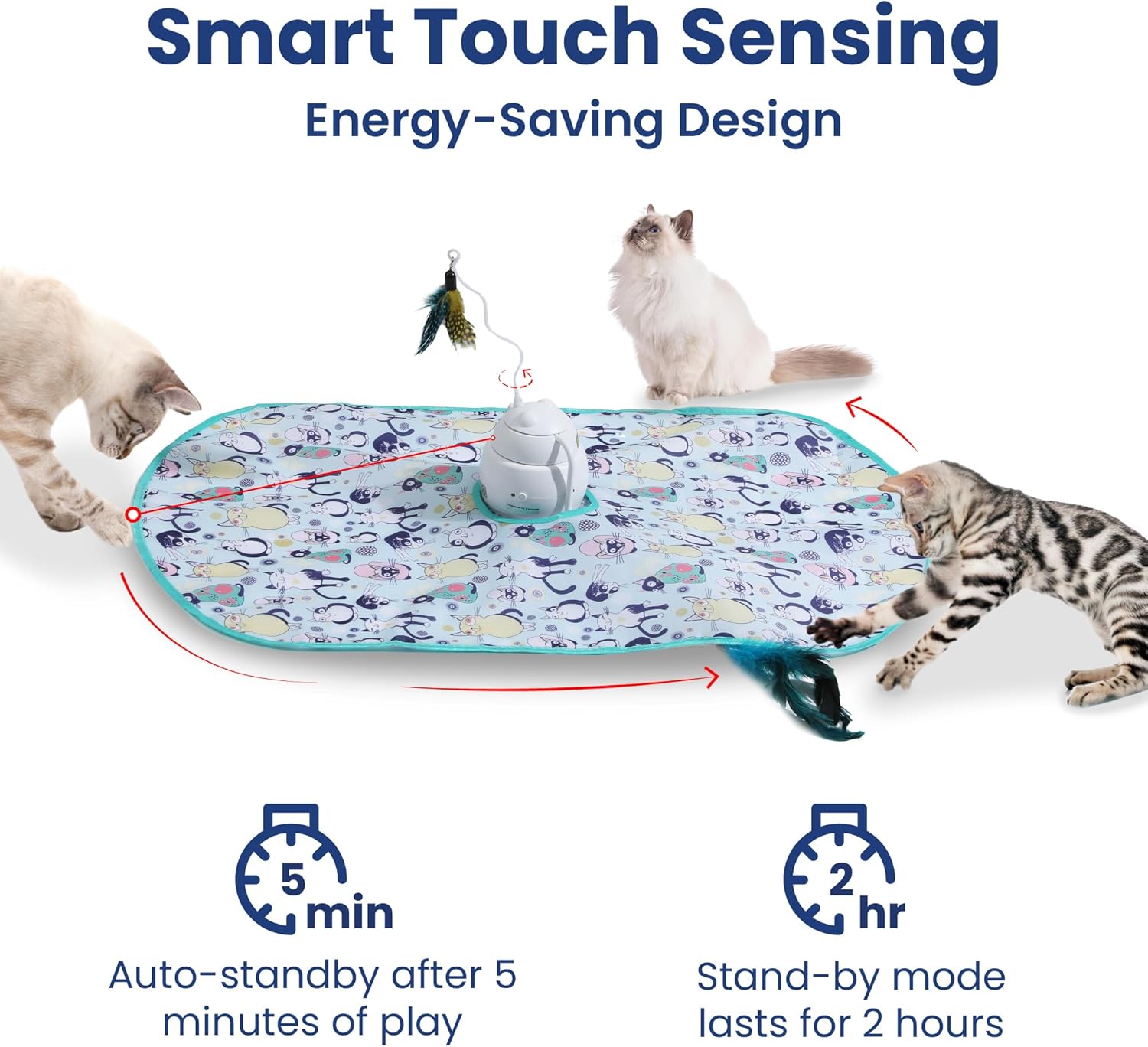
Motorized toys — think battery-powered spinning feathers, automated laser projectors, or robotic mice that zip around the floor — can be a lifesaver for busy households. They let cats engage in predatory play even when no human is available to operate a wand. Many cats take to them immediately; others need a few cautious sniffs before engaging.
A word on laser pointers: they’re genuinely exciting for cats because the dot moves exactly like fleeing prey, but they can cause frustration if play never ends with a “catch.” Always finish a laser session by moving the beam to a physical toy your cat can pounce on and grab — this completes the prey sequence and leaves them satisfied rather than frazzled. For the same reason, avoid making laser play the only form of interactive play your cat gets.
Sensory Enrichment
Catnip Toys, Silver Vine & Valerian
About 50–70% of cats carry the gene that makes them respond to catnip — the rest are completely indifferent. If your cat is a responder, a well-stuffed catnip kicker or catnip-marinated mice can trigger a blissful five to fifteen minutes of rolling, bunny-kicking, and general euphoria. It’s harmless and genuinely fun to watch.
For cats who don’t respond to catnip, silver vine is worth trying. Research suggests it activates similar receptors and works on a broader percentage of cats — including many that stay cold to catnip. Valerian is a third option with a more pungent, musky appeal. Offering one of these occasionally as a special treat keeps the association strong and the response enthusiastic
🐾 🐾 🐾
The best toy for your cat is ultimately the one that gets them moving, thinking, and engaged — and the only way to know is to try. Pay attention to which toys prompt your cat to stalk and crouch before pouncing (a good sign), which ones they carry around between play sessions (they genuinely love those), and which ones collect dust after a week (rotate them out and try something new).
Enrichment isn’t a luxury for indoor cats — it’s a necessity. A cat that plays regularly is calmer, healthier, and far better adjusted than one who spends all day sleeping in quiet boredom. Consider play as essential as food, fresh water, and vet visits. Your cat will thank you — in their own enigmatic, slow-blink sort of way.